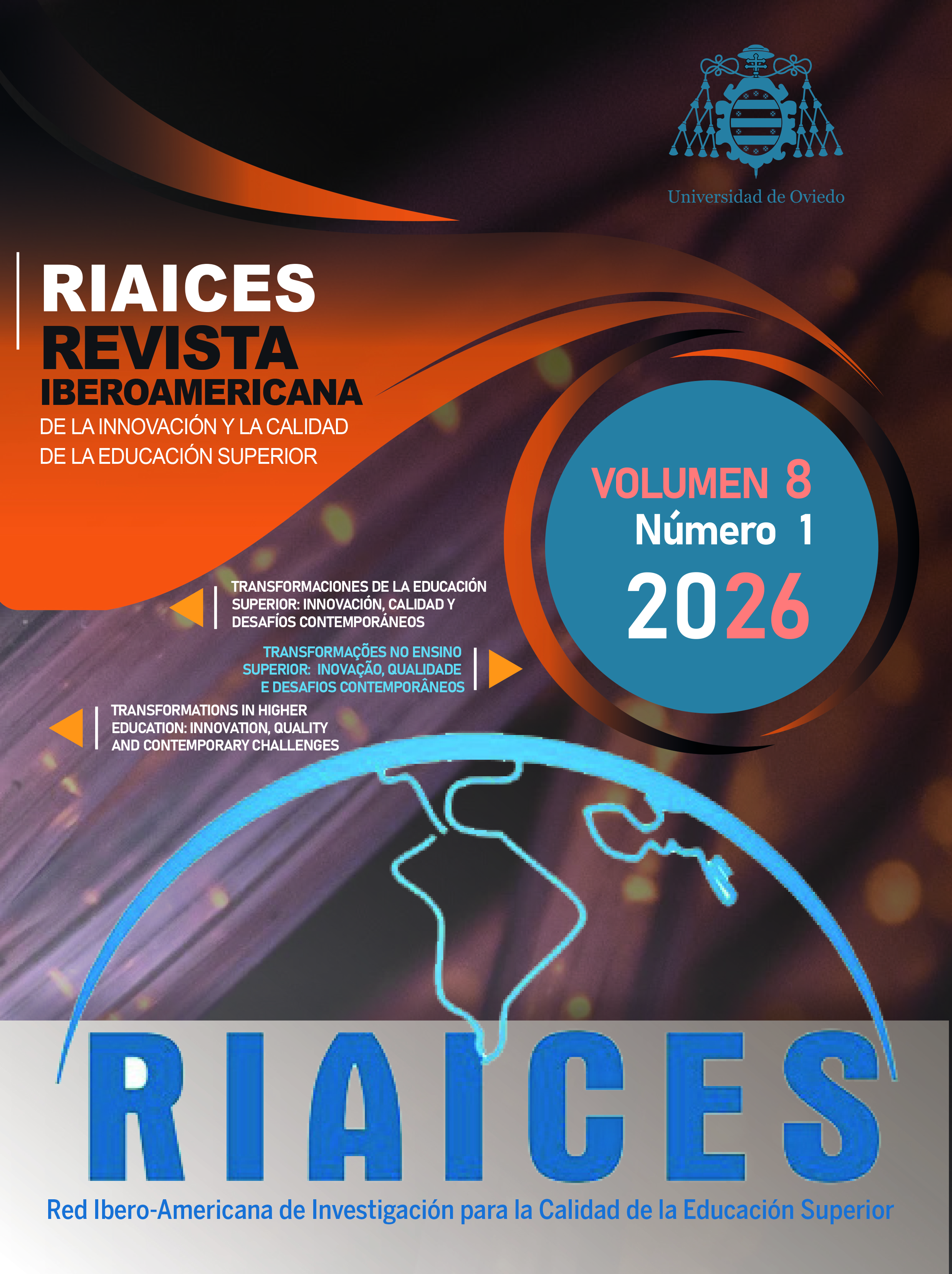
Vol. 8 No. 1 (2026): Transformations in Higher Education: innovation, quality and contemporary challenges.

Higher education is undergoing one of the most profound transformations in its history. Technological acceleration, the rapid development of artificial intelligence, the expansion of digital ecosystems, the internationalization of knowledge, new labour market demands and the increasing complexity of social challenges are redefining the traditional functions of universities. In this context, higher education institutions can no longer be limited to transmitting knowledge; they are called upon to become organisations capable of learning, adapting, innovating and leading processes of social transformation.
This scenario poses challenges that go far beyond the incorporation of new technologies or the revision of curricula. We are witnessing a paradigm shift that requires rethinking governance, pedagogical models, quality assurance systems and, above all, the very mission of the university as an institution devoted to knowledge creation, citizenship and human development.
Educational innovation, understood from this broader perspective, has become an essential condition for the sustainability of higher education systems. However, innovation is not simply about replacing the old with the new. Rather, it involves generating meaningful responses to emerging challenges through systematic research, critical reflection, experimentation and continuous improvement. Innovation becomes truly valuable when it strengthens educational quality, broadens learning opportunities, promotes inclusion and responds ethically and responsibly to society's needs.
At the same time, the concept of quality has evolved considerably over recent decades. While it was once primarily associated with evaluation, accreditation and compliance with standards, it now encompasses broader dimensions such as equity, social relevance, sustainability, internationalisation, institutional ethics, the well-being of academic communities and the capacity to generate scientific and social impact. Quality should therefore be understood not as a final destination but as an ongoing process of institutional learning.
The contributions included in this issue of the RIAICES – Ibero-American Journal of Innovation and Quality in Higher Education reflect this conceptual evolution. From diverse methodological and epistemological perspectives, they address university governance through the lens of complex thinking, curriculum reforms and their implications for educational equity, educational standardisation and quality assurance processes, active learning methodologies as strategies for meaningful learning, and philosophical reflections on the purpose of education in a world characterised by uncertainty and accelerated change. The issue is complemented by a scholarly book review devoted to the historical memory of rural schooling, reminding us that educational innovation is firmly rooted in the pedagogical heritage built by previous generations.
Beyond their thematic diversity, these contributions share a common concern: understanding higher education as a complex, open and dynamic system in which individuals, organisations, technologies, communities and territories interact continuously. Fragmented solutions are no longer sufficient to address challenges that are inherently systemic.
From this perspective, educational research has the responsibility to advance conceptual frameworks capable of integrating scientific knowledge, human intelligence, collective intelligence and artificial intelligence in support of learning, innovation and sustainable development. Universities in the twenty-first century require models that promote continuous adaptation, anticipation of emerging scenarios, evidence-informed decision-making and collaborative knowledge creation.
At RIAICES, we believe that the future of higher education lies in the consolidation of institutions that evolve from organisations focused on managing information into genuine Adaptive Intelligent Edusystems: systems capable of observing their environment, interpreting evidence, learning from experience, collaborating through national and international networks, integrating artificial intelligence in an ethical manner and transforming knowledge into innovation with tangible social impact. This vision is not merely a theoretical proposal; it is an invitation to rethink governance, teaching, research and knowledge transfer from an integrative, humanistic and socially responsible perspective.
This vision also calls for strengthening Ibero-American scientific cooperation. The cultural, institutional and educational diversity of our region represents one of its greatest strengths. We share common challenges while benefiting from innovative experiences that enrich mutual learning and facilitate the transfer of knowledge across contexts. Open science, international collaboration and academic networking will remain essential pillars for building more resilient, inclusive and sustainable higher education systems.
With this new volume, RIAICES reaffirms its commitment to scientific excellence, methodological rigour and the dissemination of knowledge that contributes to improving higher education throughout Ibero-America. We aspire to consolidate the journal as a meeting point for researchers, educators, university leaders and policymakers who recognise that innovation and quality are not separate objectives but inseparable dimensions of the same process of institutional transformation.
The challenges facing higher education are too complex to be addressed through isolated perspectives. They require shared intelligence, international cooperation and a strategic vision capable of integrating tradition and innovation, technology and humanism, evaluation and learning, excellence and equity. This will continue to be the mission of RIAICES: to contribute, through scientific research and academic dialogue, to the development of higher education capable of responding responsibly, creatively and collaboratively to the challenges of the present and the opportunities of the future.
Emilio Álvarez-Arregui
Editor-in-Chief
RIAICES – Ibero-American Journal of Innovation and Quality in Higher Education