
Res Mobilis

Current Issue

Vol. 14 No. 21.2 (2026)
Published June 1, 2026
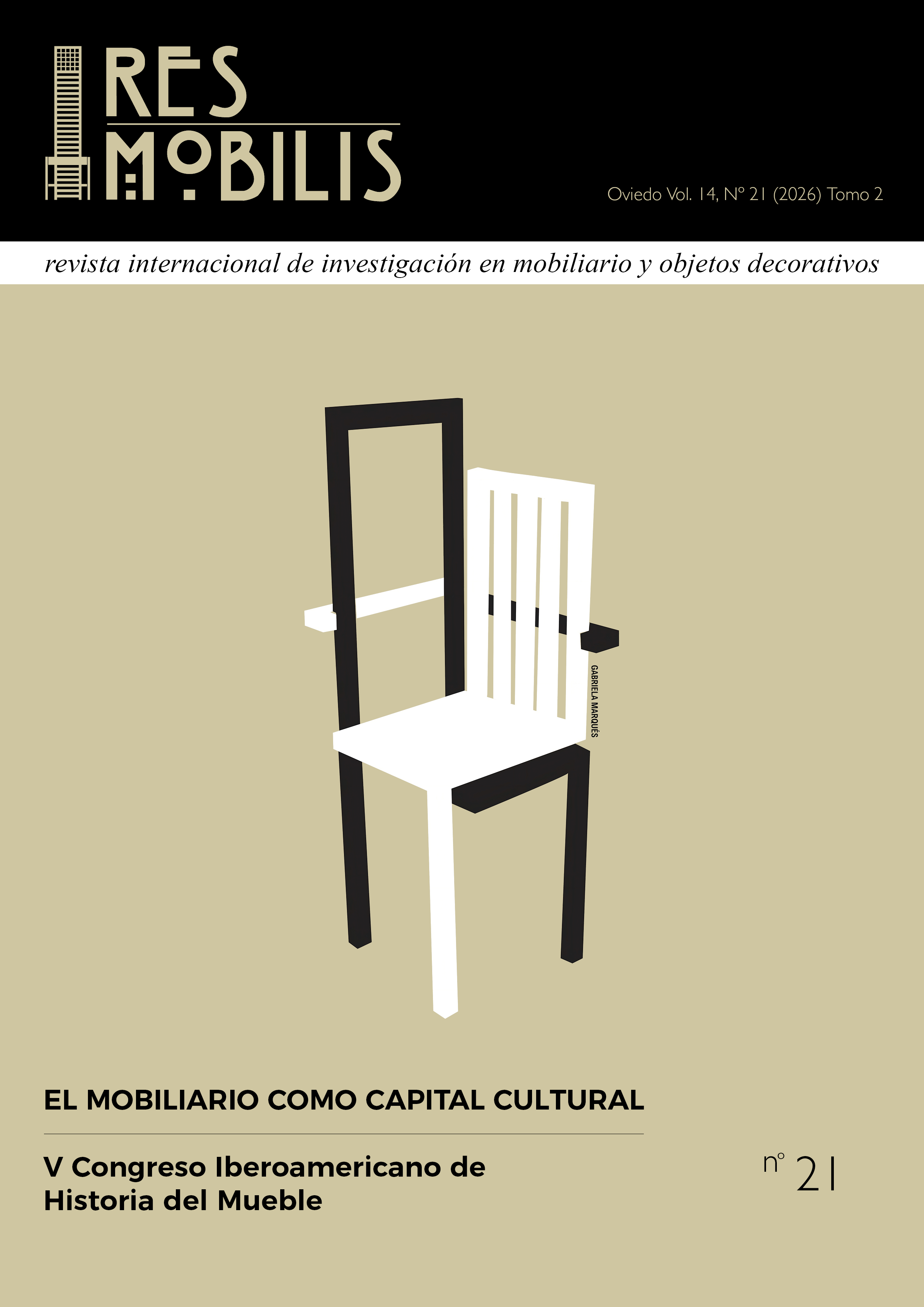
Furniture as Cultural Capital. 5th Ibero-American Congress on the History of Furniture

                    Eva Díez Paton, María Jesús Pacho Fernández y Mikel Bilbao Salsidua (eds.)

Announcements

Call for Papers Design as an Intellectual Project: Narratives, Texts, and Protagonists in the Genesis of a Discipline (1925-1975)

The field of design in general, and industrial design in particular, did not emerge as an independent discipline until nearly the final third of the 20th century. From the 1920s onwards, agents from various spheres intervened: from the creative to the industrial, including art and politics. In this context, the architect, alongside other professionals in the sector, played an essential role, carrying out a process of assimilation of the trends within their environment and the dissemination of new lines of work which, although unintended, proved crucial for the impetus and eventual constitution of design as a discipline.

Beyond the design of pieces—conceived for industrial production or as a detailed definition of the works they intended to furnish—it is worth highlighting their embryonic role in the ex novo development of a theoretical corpus on the design of objects and interiors, which could have served as a framework for the significant number of designs that followed. Reference is made here to the rich, choral legacy comprised of articles in specialized and non-specialized journals, books, exhibitions, conferences, associations, and a collection of activities and discourses of all kinds in various media. Taken together, it seems possible today to trace this effort—of a modern nature—carried out by architects with the involvement of historians, critics, patrons, artists, entrepreneurs, decorators, and engineers, extending through industry, politics, or different institutions.

If the role of the architect, decorator, or designer in this process has often gone unnoticed, this is markedly accentuated in what history has narrated and recorded regarding women. It seems necessary to rescue and highlight the work carried out by women architects, designers, and other professionals who, either in the shadow of men or as a viable professional outlet in an environment with little female sensitivity, contributed significantly to the development of design from an intellectual point of view through their words or outreach activities.


More…

June 12, 2026

Articles

Fernando R. Bartolomé García
1-19
Decorative woodcut paper as an ornamental covering on 16th-century furniture in Spain: two boxes from the Frederic Marès Museum
https://doi.org/10.17811/rm.14.21.2.2026.1-19
PDF (Español (España))
Ismael Amaro Martos
20-37
Textiles in the women’s estrados of 17th-century Spain
https://doi.org/10.17811/rm.14.21.2.2026.20-37
PDF (Español (España))
Gustavo Alejo Trujillo Yánez
38-51
Baroque props and furnishings at the service of religious images in the Canary Islands: the Rosary chest and the pedestal of the Virgin of El Pino (18th century)
https://doi.org/10.17811/rm.14.21.2.2026.38-51
PDF (Español (España))
Víctor Javier Martínez López
52-69
The oldest known Iberian square piano. An exceptional piece of furniture, organology, and anthropology at the National Music Museum of Portugal. Restoration, recovery, conservation, and exhibition
https://doi.org/10.17811/rm.14.21.2.2026.52-69
PDF (Español (España))
Francisca Fernandes Machado
70-81
Study and Conservation-Restoration Intervention of an Italian Manicord (18th–20th Centuries) from the National Museum of Music
https://doi.org/10.17811/rm.14.21.2.2026.70-81
PDF (Português (Portugal))
Martha Eugenia Alfaro Cuevas
82-116
Claudio Pellandini. Pioneer in the production of artistic stained glass in Mexico (1872-1927)
https://doi.org/10.17811/rm.14.21.2.2026.82-116
PDF (Español (España))
Mª Mercedes Fernández Martín
117-133
Furnishing and decoration of the Government Palace on the island of Santo Domingo in 1862
https://doi.org/10.17811/rm.14.21.2.2026.117-133
PDF (Español (España))
Marize Malta
134-155
Joanna Brandt: a Danish woman in Rio de Janeiro in the first half of the 20th century and the professionalization of the decorative arts
https://doi.org/10.17811/rm.14.21.2.2026.134-155
PDF (Português (Portugal))
María Villanueva Fernández, Héctor García-Diego Villarías
156-173
Architecture in Motion: Interiors and Furniture of means of Transport Through Spanish Magazines of the 1930s
https://doi.org/10.17811/rm.14.21.2.2026.156-173
PDF (Español (España))
Pedro Feduchi Canosa, Pedro Reula Baquero
174-208
Darro. Furniture from the Sixties, Sixty Years Later
https://doi.org/10.17811/rm.14.21.2.2026.174-208
PDF (Español (España))
Manuel Martínez Torán, Chele Esteve Sendra
209-231
The evolution of school furniture based on the Federico Giner Company archive
https://doi.org/10.17811/rm.14.21.2.2026.209-231
PDF (Español (España))
María de Arana Aroca, Maria Anton-Barco
232-252
Furniture in Revista Nacional de Arquitectura and Arquitectura in the 1950s and 1960s: Carlos de Miguel’s Modern Vision
https://doi.org/10.17811/rm.14.21.2.2026.232-252
PDF (Español (España))
Juan Bravo Bravo, Ana Pascual Rubio
253-275
The Transition to Modernity in Spanish Furniture during the 1950s
https://doi.org/10.17811/rm.14.21.2.2026.253-275
PDF (Español (España))
Ana Maria Fernández García, Carmen Bermejo Lorenzo
276-294
Cole Steel in Asturias (1966–1975). Industrialization and modernization of office furniture in Spain
https://doi.org/10.17811/rm.14.21.2.2026.276-294
PDF (Español (España))
View All Issues

ISSN: 2255-2057