
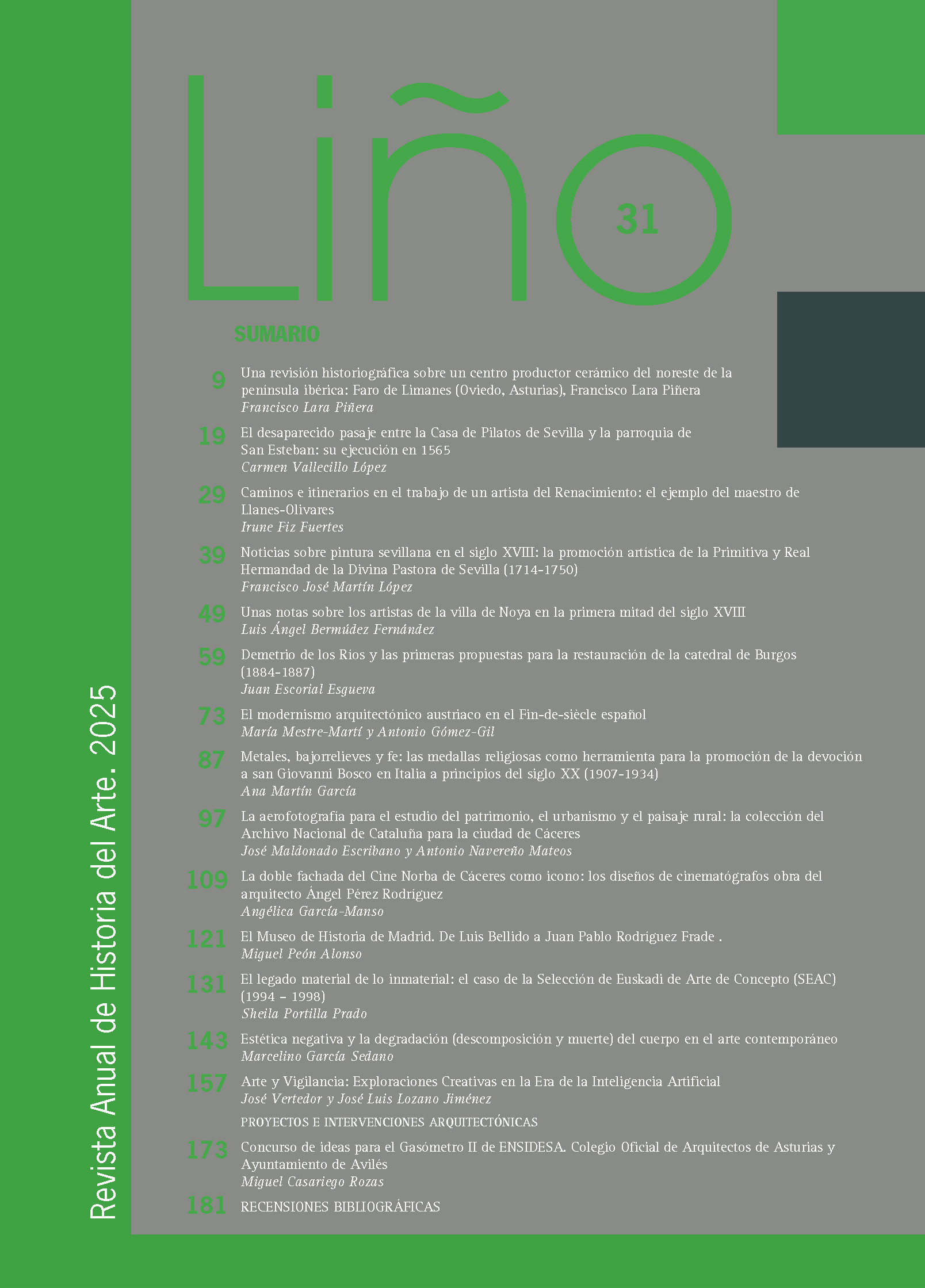
Keywords
digital privacy
AI ethics
creative resistance
technological control arte y vigilancia
privacidad digital
ética de la IA
resistencia creativa
control tecnológico
How to Cite
Abstract
The article explores how digital media and artificial intelligence (AI) have transformed surveillance and control
mechanisms in contemporary society from the perspective of artistic creation. Hyperconnectivity through the
Internet offers artists unprecedented opportunities but also raises serious privacy concerns. Artistic practice is
influenced by automation and content generation, challenging traditional notions of authorship and originality.
This framework raises profound questions about its impact on social, economic, cultural, and political life. Art
becomes a tool for critical reflection and resistance against this surveillance. Both artists and the public must
engage in this dialogue to preserve individual and collective freedom in an increasingly observed world. The
essential question is how this state can significantly influence contemporary society.
References
Adam Harvey Studio. (s.f.). “HYPERFACE”. https://bit.ly/3Tg3Fft
Archive of Digital Art. (s.f.). “Eye tracking informatics”. https://bit.ly/3pORE3W
Berardi, Franco. (2017). Fenomenología del fin. Sensibilidad y mutación conectiva. Buenos Aires: Caja negra.
Buolamwini, Joy. (2023). Unmasking AI: My Mission to Protect What Is Human in a World of Machines. Nueva York: Random House.
Castells, Manuel. (2013). “El impacto de internet en la sociedad: una perspectiva global”. En C@mbio: 19 ensayos clave sobre cómo internet está cambiando nuestras vidas, 127-148. Madrid: BBVA.
Castro, Fernando. F. (2009). Una verdad pública. Consideraciones críticas sobre el arte contemporáneo. México: Artes y ciencias visuales. Editorial documenta UAM de Estética, Historia y Teoría del Arte.
Davis, Mike. (2004). “Los Ángeles: La militarización del espacio urbano”. En M. Variaciones sobre un parque temático. La nueva ciudad americana y el fin del espacio público, editado por Michael Sorkin, 157-175. Barcelona: Gustavo Gili.
Deleuze, Gilles. (1991). “Posdata sobre las sociedades de control.” En El lenguaje literario, compilado por Christian Ferrer, 242-247. Montevideo: Ed. Nordan.
Fullerton, Jamie. (2015). “Una entrevista con Ai Wei Wei, el artista chino censurado.” Vice, 11 de julio. https://bit.ly/3PJQKQR.
González Díaz, Patricia. (2019). “Arte GPS. Referentes de las prácticas artísticas digitales relacionadas con el control.” ASRI. Arte y Sociedad. Revista de Investigación en Artes y Humanidades Digitales 17: 154-167. https://doi.org/10.5281/zenodo.7656901.
Guerrero, Mónica. (2018). “Visiones de máquina de Trevor Paglen. Lo invisible de la cultura visual.” Revista Código. Arte-Arquitectura-Diseño. Recuperado el 15 de septiembre de 2023 de https://bit.ly/3Rsnm2Q.
Hagborg-Dewey, Heather. (s.f.). “Stranger Visions.” deweyhagborg.com. https://bit.ly/3PCYwvD.
Han, Byung-Chul. (2022). Infocracia. La digitalización y la crisis de la democracia. Madrid: Ed. Taurus.
Hao, Karen, y Hilary Swart. (2022). “La IA de vigilancia promueve un ‘apartheid’ digital en Sudáfrica.” MIT Technology Review. Tecnología y Sociedad. https://bit.ly/3uRKvSY.
Hui, Yuk. (2023). Sobre la existencia de los objetos digitales. Madrid: Materia Oscura.
Kardoudi, Omar. (2022). “La tecnología China que predice los crímenes antes de que sucedan.” El Confidencial, 29 de junio. Recuperado el 15 de septiembre de 2023 de https://bit.ly/3Lt93qJ.
Martín-Prada, Juan. (2023). Teoría del arte y cultura digital. Madrid: Akal.
Martín-Prada, Juan. (2018). El ver y las imágenes en tiempo de internet. Madrid: Akal. Estudios Visuales.
Marx, Gary T. (1988). Undercover, Police Surveillance in America. Berkeley: University of California Press.
Merino, María L. (2007). “Aproximaciones microsociológicas a las interacciones vía Chat.” En Estudios sobre cuerpo, tecnología y cultura, editado por Jesús Arpal e Ignacio Mendiola, 89-102. Bilbao: Universidad del País Vasco.
Miralles-Pechuán, Luis, Héctor Ponce, y Luis Martínez-Villaseñor. (2020). “A 2020 Perspective on ‘A Novel Methodology for Optimizing Display Advertising Campaigns Using Genetic Algorithms’.” Electronic Commerce Research and Applications 40. https://doi.org/10.1016/j.elerap.2020.100953.
Mohana, y HV Ravish-Aradhya. (2019). “Object Detection and Tracking Using Deep Learning and Artificial Intelligence for Video Surveillance Applications.” International Journal of Advanced Computer Science and Applications 10 (12): 517-530. https://doi.org/10.14569/IJACSA.2019.0101269.
Murray, Martin J. (2022). The Infrastructures of Security: Technologies of Risk Management in Johannesburg. Ann Arbor: University of Michigan Press. https://doi.org/10.3998/mpub.11628530.
Olivares, David. (2019). “Así es Megvii, la empresa china de reconocimiento facial automático valorada en 3.500 millones de dólares.” Muypymes, 2 de octubre. https://bit.ly/3ra7uHx.
Peirano, Marta. (2019). El enemigo conoce el sistema. Manipulación de ideas, personas e influencias después de la economía de la atención. Barcelona: Penguin Random House Grupo Editorial.
Poitras Santos, Jill. (2021). Monitor: Surveillance, Data, and the New Panoptic. Portland: Institute of Contemporary Art at Maine College of Art and Design.
Sadin, Éric. (2009). Surveillance globale: Enquête sur les nouvelles formes de contrôle. París: Climats/Flammarion.
Sanguinetti, Pablo. (2023). Tecnohumanismo. Por un diseño narrativo y estético de la inteligencia artificial. Madrid: Ed. La Huerta Grande.
Senra Barja, Ana C. (2019). “Videoarte: nuevos medios y nuevas tecnologías.” Art-Toolkit UOC. https://bit.ly/44QdRgU.
Tegmark, Max. (2018). Vida 3.0. Qué significa ser humano en la era de la inteligencia artificial. Madrid: Taurus.
Varela, Javier. (2010). “Defensa del enlace.” Público, 26 de enero. https://bit.ly/42XkRb7.
VIDEONALE.19. (2023). “Alaa Mansour. المجنون الضاحك (The Mad Man’s Laughter).” https://bit.ly/46RW8GW.
Viola, Paul, y Michael J. Jones. (2004). “Robust Real-Time Face Detection.” International Journal of Computer Vision 57: 137-154. https://doi.org/10.1023/B:VISI.0000013087.49260.fb.
Yao, Zhen, Xue Zhou, Hong Qin, y Wei Xiao. (2020). “Monitoring Interface Design Based on Real-Time Fatigue Detection.” En Proceedings of the 2020 4th International Conference on Big Data and Internet of Things (BDIOT '20), 49-53. Association for Computing Machinery, Nueva York, NY, USA. https://doi.org/10.1145/3421537.3421556.
Yang, Christina. (2022). “The Complicated Danger of Surveillance.” The MIT Technology Review, 11 de octubre. https://bit.ly/3qZUBQh.
YCAM. (2011). “Eye-Tracking Informatics.” YCAM. https://bit.ly/42Keqs7.
Zafra, Remedios. (2022). El bucle invisible. Oviedo: Ediciones Nobel.
Zuboff, Shoshana. (2020). La era del capitalismo de la vigilancia. La lucha por un futuro humano frente a las nuevas fronteras del poder. Barcelona: Paidós. Estado y Sociedad.

This work is licensed under a Creative Commons Attribution-NonCommercial-NoDerivatives 4.0 International License.