
Keywords
Vanguardias
Fauvismo
Pintura
Lesbos Matisse
Avant-garde
Fauvism
Painting
Lesbos
How to Cite
Abstract
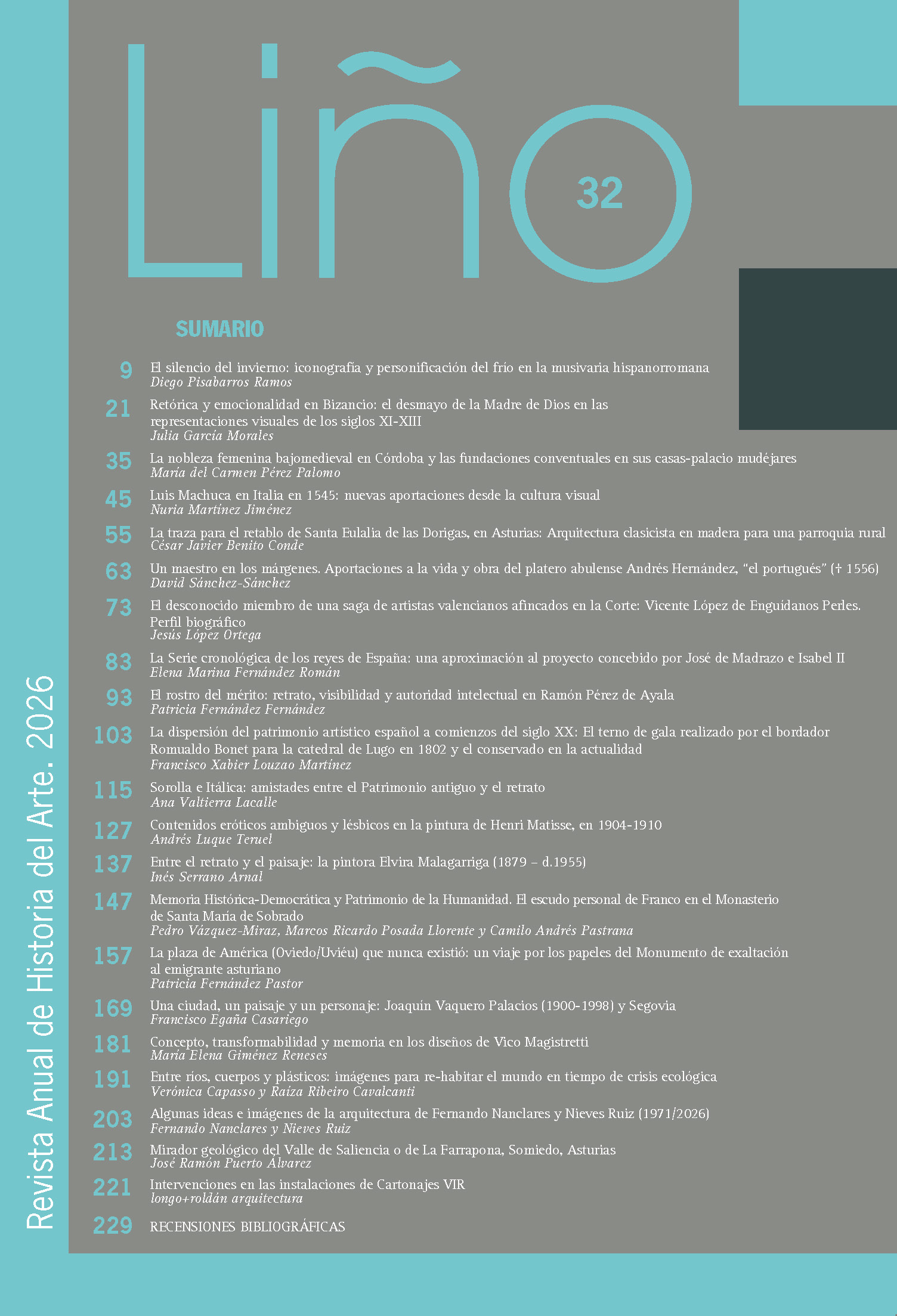
This article analyzes ambiguous eroticism and lesbian practices in a group of paintings by Henri Matisse dated between 1904 and 1910. These are paintings aimed at a female audience capable of grasping the true meaning of compositions presented under the guise of another theme. The painter opted for ambiguous forms, which are not generically defined and, in this neutral condition, can be interpreted in different ways, including the possibility of relating them directly to those that explicitly depict the lesbian theme. In other cases, the clarity of the meaning in these other paintings allows us to identify the meaning of the former, in which the message is not so obvious. The painter presented lesbian relationships clearly and as a background or secondary meaning associated with another, more conventional theme, which displaces it and mitigates the social impact that focusing on it directly might have had in this time.
References
BARR, Alfred (1951): Matisse: his Art and his Public (Catálogo). Nueva York: Museo de Arte Moderno.
BOCK, Catherine C (1981): Henri Matisse and Neo-Impresionism 1898-1908. An Arbor: UMI Research Press.
CIRLOT, Lourdes (1995): Primeras vanguardias artísticas. Textos y documentos. Barcelona: Labor.
COWART, Jack; y SCHNEIDER, Pierre 1990): Matisse au Maroc. Peintures et dessins 1912- 1913. París.
DUTHUIT, Georges (1930): The Fauvist Painiter. New York.
ELDERFIELD, John (1993): Henri Matisse 1904- 1907 (Catálogo). París: Centro Georges Pompidou.
ELGER. Dietmar (1991): Expresionismo. Colonia: Benedikt Taschen.
ELSEN, Albert E (1972): The sculpture of Henri Matisse. New York.
ESSERS, Wolkmar (1992): Henri Matisse. Colonia: Benedikt Taschen.
FLAM, J (1973): Matisse on Art. Londres. FLAM, Jack (1986): Matisse, the man and his art.
Londres: Ithaca.
GADAMER, Hans George (1977): Verdad y Método. Salamanca: Ediciones Sígueme.
GOWING, Lawrence (1979): Matisse. Londres: W.W. Norton & Co.
GUICHARD MEILI, Jean (1967): Matisse. Londres: Thames & Hudson.
GUICHARD MEILI, Jean (1993): L´art de Matisse. París.
HEIDEGGER, Martin (1998): Caminos de Bosque. Madrid: Alianza.
KOSTENEVITCH, Albert; y SEMIONOVA, Natalia (1992): Matisse et la Russie. París: Flammarion.
LUQUE TERUEL, Andrés (2006): “Los bronces de la época del estilo rosa y de la derivación hacia el Clasicismo Mediterráneo como un modo primerizo de primitivismo, en 1904 a 1907”. En: Ars Longa, N. 14-15, Valencia, pp. 321-343.
MARCUSE, Herbert (1995): Eros y civilización. Barcelona: Ariel.
MATISSE, Henri (1908): La grande revue. París.
MONNERET, Sophie (1994): Matisse. La obra de una vida. Barcelona: PMI Ediciones.
MONOD-FONTAINE, Isabelle (1995): The sculpture of Henri Matisse. Londres.
NOËL, Bernard: Matisse (1983): París.
READ, Herbert (1984): A concise History of Mo- dern Painting. Barcelona: Ediciones del Serbal.
REBULL TRUDEL, Melania (1994): Matisse. Globus: Barcelona.
RUHRBERG, Karl; SCHNECKENBURGER, Manfred; FRICKE, Christiane; y HONNEF, Klaus (2005): Arte del Siglo XX, II Vol. Colonia: Taschen.
RUSSELL, John (1982): El mundo de Matisse. Amsterdam.
SCHNEIDER, Pierre (1984): Tout l´oeuvrepeint de Henri Matisse 1904-1928. París.
SPIES, Werner (1989): La escultura de Picasso. Barcelona: Polígrafa.
WARNOD, Janine (1975): Bateau-Lavoir, 1912- 1914. París: Les Presses de la Conaissance.
WHITFIELD, Sarah (1991): Fauvism. Londres. WILSON, Sarah (1995): Matisse. Barcelona.
WILSON, Sarah (1995): Matisse. Barcelona.

This work is licensed under a Creative Commons Attribution-NonCommercial-NoDerivatives 4.0 International License.